How to Choose a PPC Agency: What It Does, How It Charges, What to Ask

A PPC agency plans and runs your paid ads on Google, Meta and other platforms, and charges a management fee on top of what you pay the platforms. To choose one, find out who will actually work in your account, keep the ad accounts and tracking in your own name, and judge the agency on what a new customer costs you. Clicks and impressions come a distant second.
Say you've already burned through $50,000 on Google Ads with an agency and the results were terrible. Another list of agency names won't help much. What helps is a way to tell, before you sign anything, whether the next team will spend the money better than the last one did, and that comes down to a handful of checks you can run yourself.
PPC stands for pay-per-click, the pricing model behind Google search ads, where you pay when someone clicks. A PPC agency is a company you pay to run those campaigns for you. The term has stretched over the years, and most PPC agencies now also run ads on Meta (Facebook and Instagram), Microsoft Bing or LinkedIn, even though some of those platforms mostly charge by impressions.
Your ad budget goes to Google or Meta. The agency's fee pays for the people deciding where that budget goes and checking every week whether it went somewhere useful.
Most of the value is in unglamorous, repeated work. On Google it starts with the search terms report, the list of what people actually typed before your ad showed. Someone should read it, block the searches that will never buy (add them as negative keywords) and move budget toward the ones that turn into customers. On Meta, the weekly job is watching which ads are wearing out and getting new ones live before results slide.
Behind both sits tracking. A good agency ties every call and form back to the campaign and keyword or ad that produced it, and ideally follows it into your CRM so it can see which leads became paying customers. Without that, the agency is optimizing for whatever is easiest to count, which is usually cheap clicks.
Ads multiply whatever is already happening after the click. If the offer is weak or leads wait a day to hear back, more budget makes the problem bigger and more expensive. Some agencies only touch the ad account and will say these are your problems. Others will fix pages and follow-up for you. Know which kind you're hiring, because a lot of "the ads didn't work" stories turn out to be a phone nobody answered.
"PPC agency" covers a one-person consultant and a firm with a hundred account managers, and the difference matters more than the label. This is how the main options compare, with an in-house hire included because that's the real alternative for larger budgets.
| Option | Who does the work | Fits when | Watch for |
|---|---|---|---|
| Freelancer or consultant | One person, often senior | Smaller budgets, one platform, or a one-off account review | Everything stops when they're sick or booked up. Creative and landing pages are usually on you |
| Specialist PPC agency | A team focused on one platform, often Google | Search is clearly your main channel and the rest of your funnel already works | Problems outside the ad account, like slow follow-up, tend to go unnoticed |
| Paid media agency | Separate buyers for Google, Meta and others | You need several ad platforms run well and have your own pages and sales process | Each channel reports its own wins, and nobody owns the full number |
| Full-funnel agency | One team for ads, creative, landing pages and lead follow-up | Leads come in but too few become customers, or you're tired of coordinating vendors | A bigger scope means more to check. Ask to see how they report revenue, beyond leads |
| In-house hire | Your employee | Large, steady budgets and someone senior on your side to manage them | Salary plus tools and training, and one person rarely covers every platform well |
The in-house math is worth running before you assume it's cheaper. The Labor Department's O*NET database files this kind of work under search marketing strategists, and the Bureau of Labor Statistics figure it lists for the wider marketing specialist group is a median of $78,760 a year. That is about $6,560 a month before benefits, payroll taxes, software and the hours you spend managing the hire. Set that against the agency proposals on your desk, and remember a hire gives you one person's skills where an agency gives you a team's.

Our own bias is toward the full-funnel side, because that's how we work: we run Meta and Google ads alongside the landing pages and follow-up, and we judge the account on what a customer costs. The other boxes are still the right answer for plenty of businesses. A dentist with a solid booking process and a $2,000 search budget is usually well served by one good freelancer.
Few agencies publish prices, so learn the structures before you compare proposals. Most fees fall into one of these models, sometimes mixed:
Add a setup or onboarding charge to that list, since many agencies bill extra for the first month. That work (tracking, account structure, first round of ads and pages) is real, and an agency that skips it to look cheaper is setting the account up to fail.
Some resellers send one invoice that blends ad spend and their cut, so you never see what Google actually charged. Google's transparency requirements for third parties say management fees must be disclosed "in writing before each first purchase" and on "all customer invoices," and that cost reports must show "the exact amount charged by Google, exclusive of any fees." If an agency won't show you the platform number, treat that as the answer.
We use a simple rule of thumb, and it's plain arithmetic. To match the cost per lead you'd get running the same budget yourself, an agency has to produce more leads by the same percentage that its fee adds to your spend. A $1,500 fee on $5,000 of ad spend raises your total by 30%, so the agency needs about 30% more leads (or better ones) to break even on cost per lead.
Put a real benchmark on it. LocaliQ's search advertising benchmarks, built from thousands of its customers' Google and Microsoft Ads campaigns, put the average cost per lead for home and home improvement at $90.92. At that rate, $5,000 a month buys about 55 leads. With a $1,500 fee on top, the agency has to bring in about 72 leads from the same spend for your all-in cost per lead to stay at $90.92.
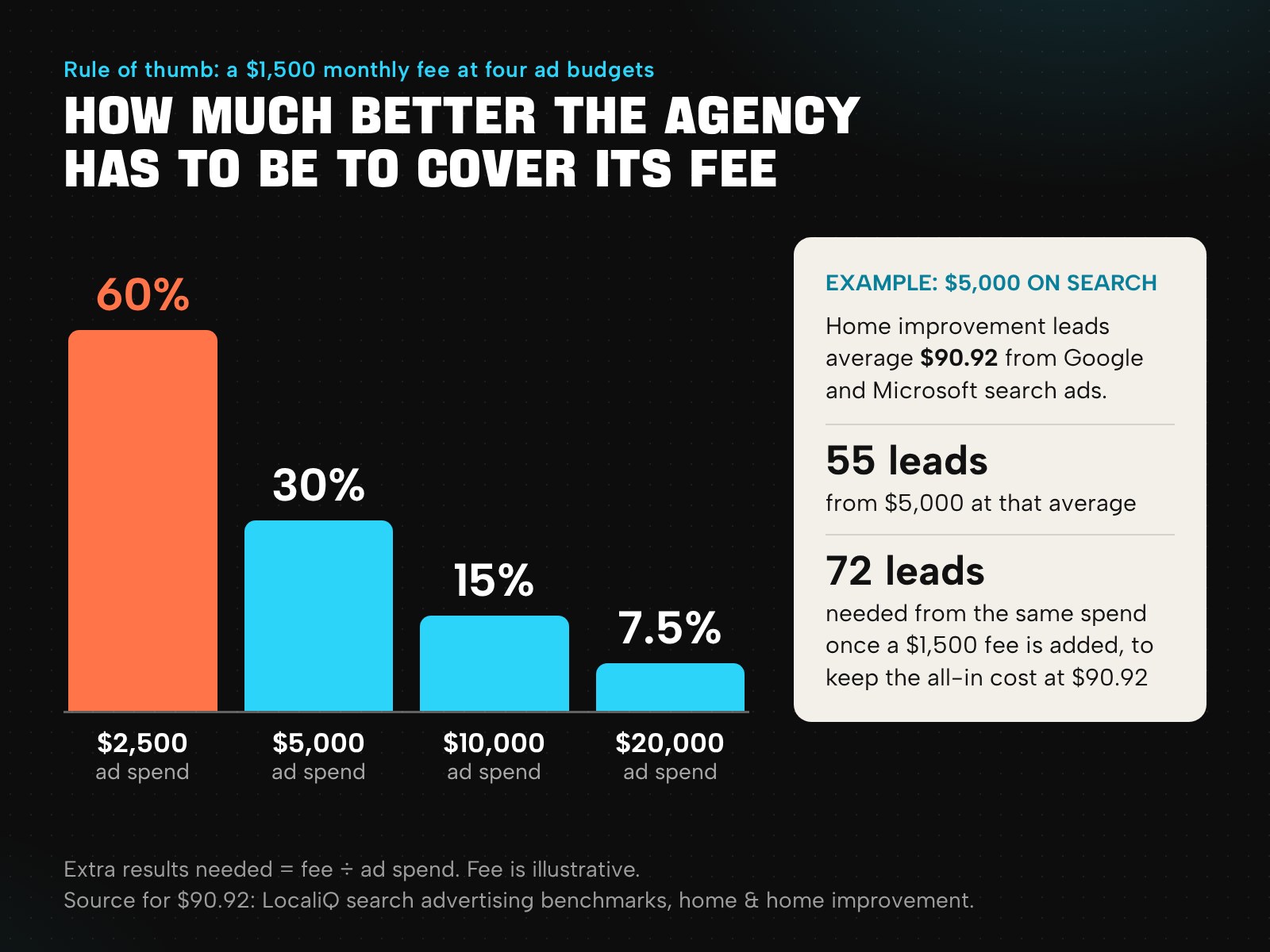
The math leaves out two things. It assumes you'd hit average results on your own, and plenty of owner-run accounts don't, which makes a good agency easier to justify. It also ignores your own time, which has a price even if nobody invoices it. Still, when the fee would be more than about a third of your ad budget, look hard at a freelancer, a one-off review of your setup, or fixing your pages and follow-up first. If you're still deciding whether to hire anyone at all, our agency vs in-house vs freelancer comparison walks through the trade-offs.
These questions are hard to bluff, because each has an answer you can check. Ask every agency on your shortlist the same ones and write the answers down side by side.
Ask for the names of the people who will make changes in your account, and how many other accounts each of them handles. A senior strategist on the sales call and a junior buyer juggling dozens of accounts afterward is a common pattern. A senior person who builds the strategy and reviews the work while someone else makes daily changes can be perfectly fine, as long as you know that's the setup and can reach the senior person.
The Google Ads account, the Meta ad account, the pixel, Google Analytics and the CRM should belong to your business, with the agency added as a user. In Google Ads, only admin access can give account access, change access levels and unlink manager accounts, so make sure someone at your company holds it. If the agency builds everything inside accounts it owns, leaving means starting from zero, history included.
Some accounts count a page view or a tap on the phone number as a conversion. Ask what fires as a conversion, whether calls are tracked by length, and whether results flow back from your CRM so the platforms learn which leads bought. An agency that can't explain its tracking in plain words is reporting on guesses.
Ask for a sample report with the client details blacked out. If the first page is impressions and click-through rate, the agency is reporting activity. You want cost per booked call and cost per customer near the top, next to the ad spend that produced them.
Get the scope in writing: how many new ads a month, who makes the videos and images, whether landing pages are included, and how often you meet. Two proposals with the same fee can cover very different amounts of work.
A good agency will name the numbers and the timing up front. Cost per lead shows up within a couple of weeks on most accounts. Cost per customer takes as long as your sales cycle, which might be a few weeks for a gym and a few months for a remodeler.
It's a reasonable thing to ask, as long as you know what the badge requires. Google's Partners program asks for an optimization score of at least 70%, $10,000 in ad spend across managed accounts over 90 days, and certification for at least half of the agency's strategists. That tells you the agency is active and trained. It says nothing about whether its clients got customers at a profitable cost, so it shouldn't outweigh the answers above.
Start with your own account before you talk to anyone new. Ask the old agency for admin access to every ad account and for your Google Ads customer ID (Google's rules require third-party managers to hand it over when you ask). Then pull three things from the last 90 days: total spend straight from the platform, the search terms that spent the most, and what was being counted as a conversion. A few minutes with the search terms report can show where the waste went, for example clicks from job seekers or from towns you don't serve.
Then compare the agency's lead count with what reached your CRM or inbox. A gap usually means the tracking counted things that weren't leads, which any new agency should fix before spending more.
A report that looks busy is one of the clearest warning signs. A generator dealer came to us after eight months with another agency: 2.9 million impressions, almost 18,000 clicks and $18,379 spent, which produced 33 form leads at about $557 each. We moved the budget into Meta ads built to get a form filled out by homeowners inside the service area. Over six and a half months the generator dealer got ten times the leads on 38% less budget, at $32.62 a lead, with 94% of them inside the service area.

When you interview replacements, give each one the same 90 days of data and ask what they'd change first. The good ones will ask about your close rate and what a customer is worth before they talk about bids.
For most local and service businesses PPC is now a two-platform decision, and the agency you hire should be able to explain which one fits and why. Search reaches people who are already looking for what you sell. Meta reaches people before they start looking, which matters when demand is thin or the service is something people don't search for until they've seen it.
The right channel shows up in revenue, which is why it's worth tracking past the lead. For a home remodeling company, we turned about $12,000 in Meta ads into $248,000 in signed remodels. Each lead cost $68, which would worry anyone reading a cost-per-lead report. But the remodeling jobs average $80,000 or more, and each signed one took about $4,000 in ads to win.
If search is your main channel, our Google Ads management page shows how we run it, from weekly search term reviews to sending sales back to Google. If Facebook and Instagram fit better, the Meta ads agency page covers that side. Most of our clients run Meta and add search where people are already looking.
Still torn between the two? Our Google Ads vs Facebook ads comparison breaks down cost per lead on each and what happened when we ran them side by side.
An agency can't create demand for an offer nobody wants. If you've never sold the service at the price you plan to advertise, test it with your existing customers or referrals first, since paid ads are an expensive way to find out the offer is wrong.
Slow follow-up is the other common reason to wait. People who search tend to call around, and if your team calls back the next afternoon, someone else got the job. Fix the response time, even if that only means an automatic text and a calendar link, before buying more clicks.
Budget matters too. If the break-even math above says an agency would need to double your results to cover its fee, put the money into ads and a one-time setup review instead, and revisit the decision when spend grows.
If you'd like a second opinion on your current account, a growth audit is a 45-minute call where we go through your offer, ads, follow-up and numbers with you and work out what a customer costs you today.
A PPC agency is a company that manages pay-per-click advertising for other businesses. It plans campaigns, writes and tests ads, sets up tracking and adjusts budgets on platforms like Google Ads and Meta. You pay the ad platforms for clicks or impressions and pay the agency a separate management fee.
Fees are usually a flat monthly amount, a percentage of ad spend, or the greater of a minimum and a percentage, plus a setup charge in some cases. The useful test is the share of your total budget the fee takes. A $1,500 fee on $5,000 of ad spend adds 30%, so the agency needs about 30% better results than you'd get alone to break even.
Your business should own the Google Ads and Meta ad accounts, the tracking and the CRM, with the agency added as a user. Keep admin access on your side. If you ever switch agencies, the account history, audiences and conversion data stay with you.
It means the agency meets Google's minimums: an optimization score of at least 70%, $10,000 in managed ad spend over 90 days and certified strategists. Treat it as a sign the agency is active on Google, then ask separately what a customer cost on accounts like yours.
Cost per lead is usually clear within the first couple of weeks. Cost per customer takes as long as your sales cycle, which can be a few weeks for a gym and a few months for a remodeler. Agree on the numbers you'll judge by, and the date you'll review them, before the first ad runs.
Last updated: 2026-10-16
